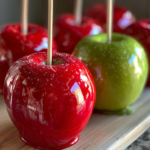
Description
This candy apple recipe gives you a perfectly glossy, hard-crack sugar coating that shatters cleanly on the first bite — every single time. Made with just 5 pantry ingredients and ready in 30 minutes, these classic homemade candy apples bring back every carnival and Halloween memory you have. No sticky coating, no cloudy finish, no guesswork — just the real thing, made right in your kitchen. The secret is one number: 300°F. Hit that temperature and you cannot fail.
Ingredients
- 6 medium apples, firm variety — Granny Smith (tart) or Fuji (sweet) strongly recommended
- 2 cups (400g) granulated white sugar
- 1/2 cup (120ml) light corn syrup
- 3/4 cup (180ml) water
- 1/2 teaspoon red gel food coloring (gel gives deeper color than liquid)
- 1/2 teaspoon cinnamon extract or flavoring oil (optional)
- 6 wooden candy apple sticks or sturdy lollipop sticks
- Non-stick cooking spray
- Parchment paper or silicone baking mat
Instructions
- Set up your workspace before you start: line a baking sheet with parchment paper and coat lightly with non-stick cooking spray. Have your sticked apples ready and within reach. Once the sugar reaches temperature, you must move fast — preparation is everything.
- Remove all wax from your apples. Store-bought apples have a food-grade wax coating that will prevent the candy from sticking and cause bubbles. Dip each apple in boiling water for 5 seconds, then scrub dry with a rough kitchen towel. Insert a wooden stick firmly into the stem end of each apple, pushing it at least halfway through. Set aside on your prepared baking sheet.
- In a heavy-bottomed medium saucepan, combine the sugar, corn syrup, and water. Stir gently just until the sugar is moistened. Clip a candy thermometer to the side of the pan, ensuring the tip is submerged in the mixture but not touching the bottom of the pan — an inaccurate reading will ruin the coating.
- Place the saucepan over medium-high heat. Bring the mixture to a full rolling boil without stirring. Once boiling, use a wet pastry brush to wipe down any sugar crystals clinging to the sides of the pan — any crystals that fall back in can cause the whole batch to crystallize.
- Continue boiling, without stirring, until the candy thermometer reads between 300°F and 310°F (149°C–154°C) — this is the hard crack stage. This takes approximately 15 to 20 minutes. The temperature will climb slowly at first, then speed up dramatically near the end. Do not walk away during the last 5 minutes.
- Remove the pan from heat immediately once it hits 300°F. Stir in the gel food coloring and cinnamon extract if using. Do not overstir — a few gentle turns are enough. Now wait. Allow all the bubbles to fully subside, about 1 to 2 minutes. Dipping into a bubbly syrup will leave a textured, uneven coating on your apples.
- Tilt the saucepan to one side so the syrup pools deeply in one corner — this makes full coverage easier. Working one apple at a time, dip and rotate each apple to coat completely, letting the excess drip back into the pan for 3 to 4 seconds. Place each coated apple stick-side up on the prepared baking sheet. Do not touch or move the apples while they set. Allow to cool completely at room temperature for at least 20 minutes before serving. The coating will harden to a glass-like finish.
Notes
- Why is my candy apple coating sticky or chewy? The syrup did not reach 300°F (hard crack stage). Even a few degrees short — at 290°F or 295°F — leaves too much water in the sugar, resulting in a soft, taffy-like texture instead of a hard shell. Always use a calibrated candy thermometer and do not remove from heat early.
- Why is my candy apple coating cloudy or full of bubbles? You dipped before the bubbles fully settled after adding the food coloring. Always wait 1 to 2 full minutes after removing from heat until the surface is completely still and glossy before dipping.
- Why won’t the coating stick to my apple? The apple surface was still waxy or slightly wet. Wax and water both prevent sugar adhesion. Remove wax with a 5-second boiling water dip, then dry completely with a rough towel before dipping.
- Never refrigerate candy apples. Cold air and humidity cause the hard candy coating to absorb moisture and turn sticky. Store at room temperature, uncovered or loosely wrapped, and eat within 1 to 2 days for the best texture.
- If the syrup thickens too much while dipping, return the pan to low heat for 20 to 30 seconds to loosen it. Do not add water.
- To make candy apples without corn syrup: substitute with 1 teaspoon of white vinegar or fresh lemon juice. This prevents sugar crystallization the same way corn syrup does.
- For Halloween candy apples: swap red gel coloring for black, deep purple, or forest green to get a spooky, dramatic finish. Black food coloring works best with extra-black gel, not regular black.
- Best day to make candy apples: a cool, dry, low-humidity day. On humid days, the coating will stay tacky even after cooling completely. Avoid making these on rainy days or in a steamy kitchen.
- Apple variety matters: Granny Smith gives a tart-sweet contrast that cuts through the sugar coating. Fuji and Honeycrisp are sweeter and equally firm. Avoid soft varieties like McIntosh or Red Delicious — they go mushy under the hot sugar.
Nutrition
- Calories: 271
- Sugar: 65
- Sodium: 3
- Fat: 1
- Carbohydrates: 71
- Fiber: 4
- Protein: 1
- Cholesterol: 0
Keywords: holiday dessert recipes, candy apple recipe, homemade candy apples, easy candy apple recipe, Halloween candy apples, candy apple without corn syrup, hard crack candy apples, glossy candy apples, candy apples from scratch, fall candy apple recipe, carnival candy apples, how to make candy apples, candy apple tips, sticky candy apple fix, best apples for candy apples